This article originally appeared in ANA Magazine and is republished here with permission. You can read the original article on the ANA website.
It is indisputable that artificial intelligence (AI) is transforming how work gets done—and, no surprise, marketing is front and center when it comes to this transformation. The shift AI is driving requires marketing leaders to adapt their talent strategy to keep from falling behind, potentially way behind.
As Vinciane Beauchene, global lead on human x AI at BCG, stated, AI transformation must also coincide with investing in human talent, noting that "transformation must be accompanied by a clear people strategy and development engine to boost adoption and tackle the impacts it will have on work, the worker and the workforce."
To understand why change is so critical, it helps to level set on AI's impact across marketing. First, AI has amplified the performance pressures marketing felt before AI burst onto the scene. This means expectations to deliver more with less are now greater—and that managing constant change and uncertainty will remain the "new normal."
Second, given its capabilities, AI effectively operates as a team member, introducing new organizational dynamics and complexity. As such, team structures and performance management must adjust to get the most out of AI and human collaboration.
Last, and most obviously, AI works as a force multiplier, vastly increasing marketing's speed and volume. This can result in human involvement becoming less about execution and more about orchestrating positive outcomes. As a force multiplier, AI also introduces new risks to be managed.
Five Ways Marketing's Talent Strategy Must Change to Thrive in the New AI Operating Reality
1. Create a structure that reinforces the benefits of human and AI collaboration.
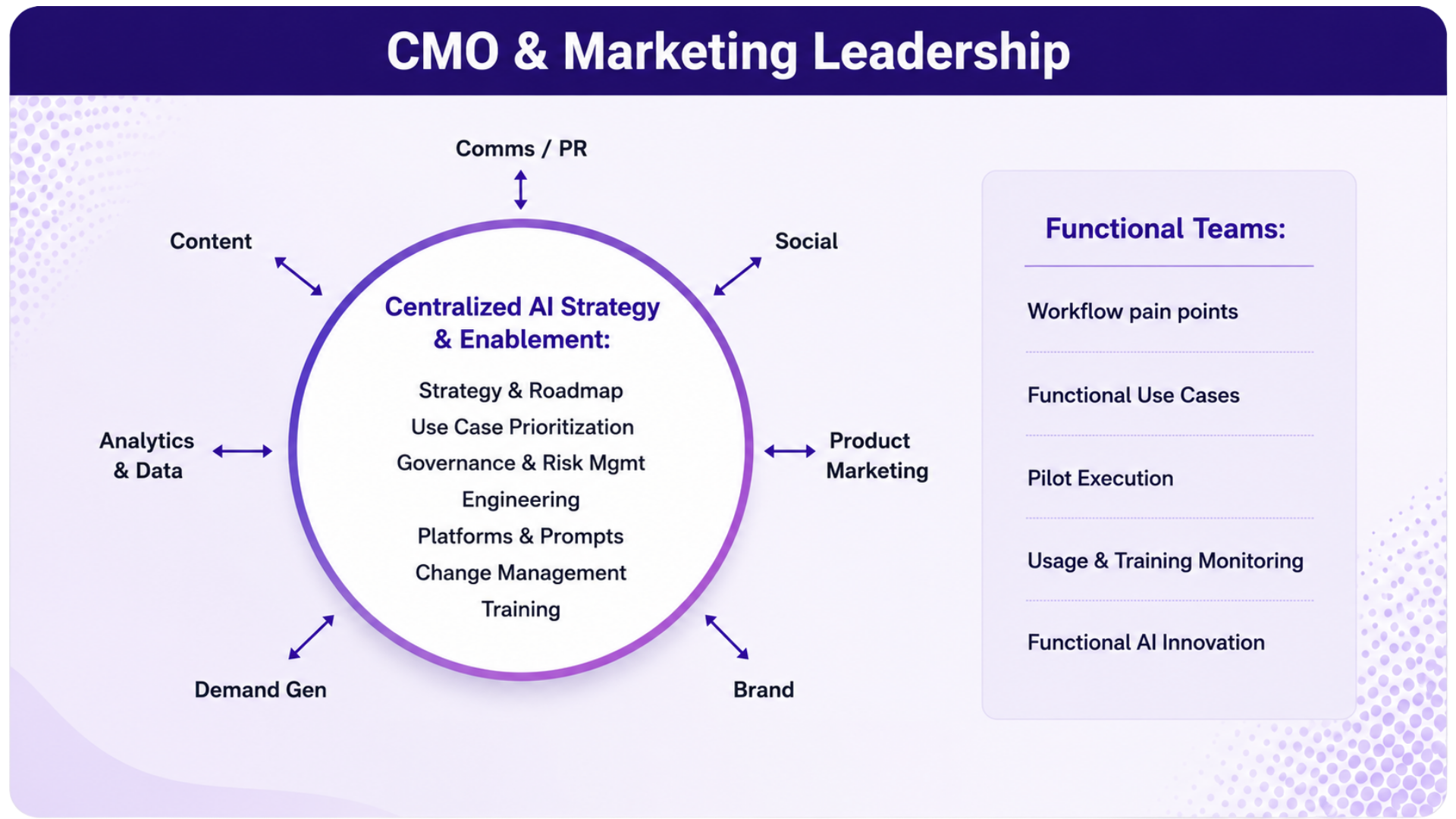
AI is like adding a new (overachieving) team member with broad impact. Teams must adjust their organizational set-up and practices to get the most out of their capabilities. A hub and spoke model with a centralized AI team builds capability faster with a single place for strategy, governance, and enablement. Each function then applies those capabilities to drive the best possible outcomes. Here is a simplified view:
Because AI increasingly takes on routine execution, people have more time to focus on driving desired outcomes. Organizing marketing talent into outcome-based teams, e.g., demand generation, loyalty, and retention, will create more accountable talent pods dedicated to creating value rather than perfecting tactical execution.
2. Develop talent capabilities to successfully deliver outcomes through AI-powered workflows.
As teams move from ad hoc AI experimentation to workflows with AI at the center, talent needs to be prepared. This requires AI fluency and foundational knowledge about how the technology works, what it can and cannot do, and the associated risks. This awareness helps talent have good judgement.
Going a level deeper, talent must possess the skills to successfully orchestrate AI-powered workflows by playing the role of conductor across integrated systems of tech and humans. With AI doing more of the routine workflow execution, it's essential to build and measure talent capabilities that drive the right outcomes, paying close attention to:
Strategy articulation with a focus on analytical rigor, originality, and differentiation
Prompting and briefing to drive quality outputs
Orchestrating work, including reviews, judgement calls, decision making, and exception handling
Experimentation and optimization at both the output and systems level
Risk management and stewardship that protects quality, brand, data, legal, and other standards
3. Build an integrated extended workforce to meet AI's operating demands.
An effective extended workforce of freelancers, contractors, and firms provides access to specialization and helps teams move faster, nimbler, and with greater flexibility — which are all critical for success in the AI era. To create an extended workforce that is core to operations, leading brands follow a few common best practices:
They organize trusted freelancers and contractors into custom talent pools, in advance of needs.
When ready to engage talent, they follow universal standards for key processes such as worker classification, contracting, onboarding, payment, and compliance.
They create ongoing agility through integrated workforce planning that accounts for full time talent as well as the extended workforce.
They manage their extended workforce through a talent tech stack that automates the rapid sourcing, selection, compliant hiring, and ongoing engagement of on-demand talent.
4. Recalibrate talent sourcing to find AI-fluent talent that meets marketing's needs.
Sourcing talent with domain expertise remains critical. However, to find talent that will be successful in the new AI operating reality, teams need expanded sourcing channels. These should include proven external partners and a direct sourcing program that provides quality AI-fluent talent from the company's valued networks, e.g., trusted alumni and former consultants. Sourcing should also satisfy diverse use cases for talent focus (dedicated AI specialists versus AI-enabled marketing practitioners) and engagement needs (full/part time, freelancers, contractors, agencies, and fractional).
In addition to expanded channels, key steps of the sourcing process should be modernized:
Audit sourcing tools to determine how AI can improve the reach, speed, and quality of sourcing efforts.
Update hiring criteria for AI operational success, e.g., AI fluency, adaptability, good judgement, cross-discipline collaboration, and curiosity.
Move from traditionally reactive sourcing to building talent pools that provide an always-on pipeline of vetted talent in advance of the requisition.
5. Develop a practical governance model that enables teams to move with confidence and speed.
Because AI reduces human involvement and goes deep into execution, governance needs to be clear, actionable, and grounded in providing stakeholders with transparency.
Talent-friendly governance starts with clarifying the company-wide non-negotiable policies to protect against high-risk areas such as data, privacy, security, legal, and acceptable usage and vendors. For the marketing organization, governance should be workflow specific, detailing human roles and responsibilities for reviews, decision making power, and escalation. And wherever possible, workflow guardrails should be imbedded in the tech itself.
Talent-friendly governance also checks three boxes for ongoing program-wide effectiveness:
Degrees of risk. Differentiate where teams have relatively more freedom to operate or experiment, and where higher risk areas require more stringent guardrails and reviews.
Feedback loops. Regularly assess governance effectiveness to ensure risk management is balanced with responsible speed and continued innovation.
Applied training. Create training that demonstrates how governance is applied in each role's day-to-day tasks.
Bold Leadership Must Drive Systemic Change for Marketing Teams to Thrive in the Age of AI
AI is not only about technology adoption. It is about redesigning the talent model so marketing organizations can operate with more speed, adaptability, and impact. This will take bold marketing leadership to set the vision and empower their teams.
McKinsey's 2025 research report, "Superagency in the workplace: Empowering people to unlock AI’s full potential," notes that the "technology is already highly capable and rapidly advancing, and employees are more ready than leaders think. Leaders have more permission space than they realize to deploy AI quickly in the workplace. To do so, leaders need to stretch their ambitions toward systematic change, laying the foundation for real competitive differentiation."
Ultimately, establishing and developing the five calls to action highlighted above provides marketing leadership with a practical path to realize the full potential of AI in the workforce, enhancing marketers' work to achieve better outcomes with technology as an enabler of success.
No items found.
No items found.
To learn more about any or all of these solutions, contact your Wripple Client Lead, or request a demo.
This article originally appeared in ANA Magazine and is republished here with permission. You can read the original article on the ANA website.
It is indisputable that artificial intelligence (AI) is transforming how work gets done—and, no surprise, marketing is front and center when it comes to this transformation. The shift AI is driving requires marketing leaders to adapt their talent strategy to keep from falling behind, potentially way behind.
As Vinciane Beauchene, global lead on human x AI at BCG, stated, AI transformation must also coincide with investing in human talent, noting that "transformation must be accompanied by a clear people strategy and development engine to boost adoption and tackle the impacts it will have on work, the worker and the workforce."
To understand why change is so critical, it helps to level set on AI's impact across marketing. First, AI has amplified the performance pressures marketing felt before AI burst onto the scene. This means expectations to deliver more with less are now greater—and that managing constant change and uncertainty will remain the "new normal."
Second, given its capabilities, AI effectively operates as a team member, introducing new organizational dynamics and complexity. As such, team structures and performance management must adjust to get the most out of AI and human collaboration.
Last, and most obviously, AI works as a force multiplier, vastly increasing marketing's speed and volume. This can result in human involvement becoming less about execution and more about orchestrating positive outcomes. As a force multiplier, AI also introduces new risks to be managed.
Five Ways Marketing's Talent Strategy Must Change to Thrive in the New AI Operating Reality
1. Create a structure that reinforces the benefits of human and AI collaboration.
AI is like adding a new (overachieving) team member with broad impact. Teams must adjust their organizational set-up and practices to get the most out of their capabilities. A hub and spoke model with a centralized AI team builds capability faster with a single place for strategy, governance, and enablement. Each function then applies those capabilities to drive the best possible outcomes. Here is a simplified view:
Because AI increasingly takes on routine execution, people have more time to focus on driving desired outcomes. Organizing marketing talent into outcome-based teams, e.g., demand generation, loyalty, and retention, will create more accountable talent pods dedicated to creating value rather than perfecting tactical execution.
2. Develop talent capabilities to successfully deliver outcomes through AI-powered workflows.
As teams move from ad hoc AI experimentation to workflows with AI at the center, talent needs to be prepared. This requires AI fluency and foundational knowledge about how the technology works, what it can and cannot do, and the associated risks. This awareness helps talent have good judgement.
Going a level deeper, talent must possess the skills to successfully orchestrate AI-powered workflows by playing the role of conductor across integrated systems of tech and humans. With AI doing more of the routine workflow execution, it's essential to build and measure talent capabilities that drive the right outcomes, paying close attention to:
Strategy articulation with a focus on analytical rigor, originality, and differentiation
Prompting and briefing to drive quality outputs
Orchestrating work, including reviews, judgement calls, decision making, and exception handling
Experimentation and optimization at both the output and systems level
Risk management and stewardship that protects quality, brand, data, legal, and other standards
3. Build an integrated extended workforce to meet AI's operating demands.
An effective extended workforce of freelancers, contractors, and firms provides access to specialization and helps teams move faster, nimbler, and with greater flexibility — which are all critical for success in the AI era. To create an extended workforce that is core to operations, leading brands follow a few common best practices:
They organize trusted freelancers and contractors into custom talent pools, in advance of needs.
When ready to engage talent, they follow universal standards for key processes such as worker classification, contracting, onboarding, payment, and compliance.
They create ongoing agility through integrated workforce planning that accounts for full time talent as well as the extended workforce.
They manage their extended workforce through a talent tech stack that automates the rapid sourcing, selection, compliant hiring, and ongoing engagement of on-demand talent.
4. Recalibrate talent sourcing to find AI-fluent talent that meets marketing's needs.
Sourcing talent with domain expertise remains critical. However, to find talent that will be successful in the new AI operating reality, teams need expanded sourcing channels. These should include proven external partners and a direct sourcing program that provides quality AI-fluent talent from the company's valued networks, e.g., trusted alumni and former consultants. Sourcing should also satisfy diverse use cases for talent focus (dedicated AI specialists versus AI-enabled marketing practitioners) and engagement needs (full/part time, freelancers, contractors, agencies, and fractional).
In addition to expanded channels, key steps of the sourcing process should be modernized:
Audit sourcing tools to determine how AI can improve the reach, speed, and quality of sourcing efforts.
Update hiring criteria for AI operational success, e.g., AI fluency, adaptability, good judgement, cross-discipline collaboration, and curiosity.
Move from traditionally reactive sourcing to building talent pools that provide an always-on pipeline of vetted talent in advance of the requisition.
5. Develop a practical governance model that enables teams to move with confidence and speed.
Because AI reduces human involvement and goes deep into execution, governance needs to be clear, actionable, and grounded in providing stakeholders with transparency.
Talent-friendly governance starts with clarifying the company-wide non-negotiable policies to protect against high-risk areas such as data, privacy, security, legal, and acceptable usage and vendors. For the marketing organization, governance should be workflow specific, detailing human roles and responsibilities for reviews, decision making power, and escalation. And wherever possible, workflow guardrails should be imbedded in the tech itself.
Talent-friendly governance also checks three boxes for ongoing program-wide effectiveness:
Degrees of risk. Differentiate where teams have relatively more freedom to operate or experiment, and where higher risk areas require more stringent guardrails and reviews.
Feedback loops. Regularly assess governance effectiveness to ensure risk management is balanced with responsible speed and continued innovation.
Applied training. Create training that demonstrates how governance is applied in each role's day-to-day tasks.
Bold Leadership Must Drive Systemic Change for Marketing Teams to Thrive in the Age of AI
AI is not only about technology adoption. It is about redesigning the talent model so marketing organizations can operate with more speed, adaptability, and impact. This will take bold marketing leadership to set the vision and empower their teams.
McKinsey's 2025 research report, "Superagency in the workplace: Empowering people to unlock AI’s full potential," notes that the "technology is already highly capable and rapidly advancing, and employees are more ready than leaders think. Leaders have more permission space than they realize to deploy AI quickly in the workplace. To do so, leaders need to stretch their ambitions toward systematic change, laying the foundation for real competitive differentiation."
Ultimately, establishing and developing the five calls to action highlighted above provides marketing leadership with a practical path to realize the full potential of AI in the workforce, enhancing marketers' work to achieve better outcomes with technology as an enabler of success.