Shannon Denton is Co-Founder and CEO of Wripple, an on-demand talent platform helping companies build and manage flexible marketing teams. Previously Global CEO of Razorfish, Shannon has spent his career at the intersection of technology, marketing, and organizational transformation. Today, he works with marketing leaders navigating the impact of AI on talent, teams, and operating models, with a focus on building more agile, high-performing organizations.
Selected Deliverables
No items found.
About this blog series: AI is changing what marketers can do and how marketing teams get work done. In this series, we explore the evolution of the AI-enabled marketing team, from giving every marketer an AI teammate to building connected, agentic workflows. The goal: human-led, AI-powered teams that deliver better work, faster.
This article brings together our four-stage approach to AI-enabled marketing teams with practical steps to get started. For the full framework, start with The Marketing Unicorn Is Still Human.
Four stages, four posts. Here's the whole model in one place, and what I'd actually do about it.
The model
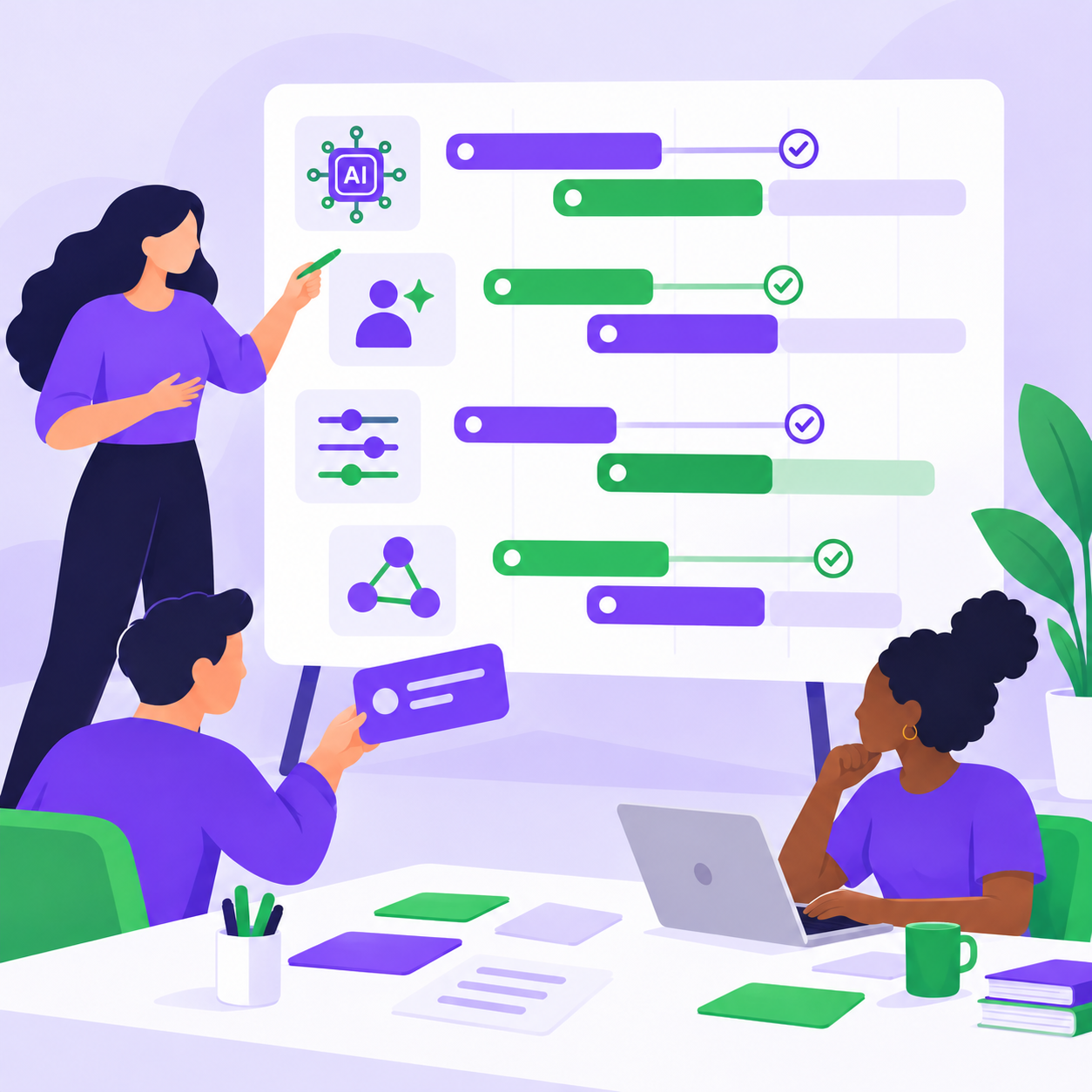
Stage 1 - Everyone Gets a Teammate. Every role picks up an AI teammate inside the work they already do. The change is individual. The benefit that compounds isn't speed, it's the floor: every role starts from a better first draft.
Stage 2 - AI-Superpowered Unicorns. One experienced marketer covers ground that used to take five, and produces a Super Brief that's coherent because one mind connected it. The change is range. The multiplier is the person, not the stack. And the best ones teach the rest of the team how.
Stage 3 - Predefined AI Delivery Modes. Before work starts, you decide how much of the execution AI carries: mostly human, human + AI, or mostly AI. The change is the team model. The benefit is that you set cost and speed up front instead of discovering them at the end.
Stage 4 - Full Agentic Workflows. AI stitches the lifecycle together and carries context across campaigns. The change is the unit of work. Months compress into days, and every campaign makes the next one smarter.
How to read the model
Three things I'd say before anyone turns this into a maturity scorecard.
It isn't a ladder. You don't complete Stage 1 and graduate to Stage 2. Most teams should be running all four at once on different work, with a brand platform handled with Stage 1 discipline while the social calendar runs at Stage 4.
Later isn't better. Stage 1 done well beats Stage 4 done badly, every time, and it isn't close. The goal isn't to reach the end. It's to be deliberate about which stage a given piece of work belongs in, and why.
Every stage is a people decision. Not one of these is primarily a technology choice. Stage 1 is a training and funding decision. Stage 2 is a talent decision. Stage 3 is an operating-model decision. Stage 4 is an organizational design decision. The tools are the easy part, which is why so much of the conversation is about them.
Four moves for the next twelve months
If you want to start this quarter, here's the sequence, roughly phased, deliberately overlapping.
Months 1–6: Build the tool matrix. One page. Role, tool, what it's for, who owns the license, what training exists. Fund the subscriptions and fund the training. This is the least glamorous item on the list and the one almost nobody has actually done.
Months 2–8: Run a Super Brief. Pick one low-complexity project that normally requires multiple roles. Have one experienced marketer carry it end to end. Compare the result on coherence, not just speed.
Months 3–10: Define three delivery modes. Take one recurring project type. Define what mostly-human, human + AI and mostly-AI each look like in terms of team, hours, cost and turnaround. Run them for six to eight months and compare. This is the experiment that will teach you the most, because it's measured on your own work.
Months 6–12: Pilot an agentic workflow. One simple use case, two or three people, stitched end to end. Low stakes, high repetition. Learn where it breaks before you widen it.
Start small. Prove it on one project type. Expand from there.
The framing I'd retire
The last two years of this conversation have been organized around human versus AI. Who wins. What's replaced. How many jobs.
I think that framing is why a lot of teams are stuck. It turns a design problem into a threat, and nobody designs well while feeling threatened. It also produces bad strategy in both directions: the teams who believe AI replaces everything build thin, generic work at scale, and the teams who believe it replaces nothing quietly fall behind on cost and speed.
The teams pulling ahead aren't picking a side. They're building something specific—human-led, AI-powered teams. Human judgment setting direction and owning the outcome. Specialized talent where craft genuinely changes the result. AI capability carrying the execution load that doesn't require a person.
That's not a compromise between two positions. It's a different thing from either.
Where we started
Lance is Wripple's unicorn, and he's been on our wall since the beginning as shorthand for the person every marketing leader has looked for and rarely found.
AI didn't make him obsolete. It made him reproducible, not as a clone, but as a capability that a lot more people can now reach, and that a whole team can operate with.
The marketing unicorn is still human. There are just more of them now.
To learn more about any or all of these solutions, contact your Wripple Client Lead, or request a demo.
About this blog series: AI is changing what marketers can do and how marketing teams get work done. In this series, we explore the evolution of the AI-enabled marketing team, from giving every marketer an AI teammate to building connected, agentic workflows. The goal: human-led, AI-powered teams that deliver better work, faster.
This article brings together our four-stage approach to AI-enabled marketing teams with practical steps to get started. For the full framework, start with The Marketing Unicorn Is Still Human.
Four stages, four posts. Here's the whole model in one place, and what I'd actually do about it.
The model
Stage 1 - Everyone Gets a Teammate. Every role picks up an AI teammate inside the work they already do. The change is individual. The benefit that compounds isn't speed, it's the floor: every role starts from a better first draft.
Stage 2 - AI-Superpowered Unicorns. One experienced marketer covers ground that used to take five, and produces a Super Brief that's coherent because one mind connected it. The change is range. The multiplier is the person, not the stack. And the best ones teach the rest of the team how.
Stage 3 - Predefined AI Delivery Modes. Before work starts, you decide how much of the execution AI carries: mostly human, human + AI, or mostly AI. The change is the team model. The benefit is that you set cost and speed up front instead of discovering them at the end.
Stage 4 - Full Agentic Workflows. AI stitches the lifecycle together and carries context across campaigns. The change is the unit of work. Months compress into days, and every campaign makes the next one smarter.
How to read the model
Three things I'd say before anyone turns this into a maturity scorecard.
It isn't a ladder. You don't complete Stage 1 and graduate to Stage 2. Most teams should be running all four at once on different work, with a brand platform handled with Stage 1 discipline while the social calendar runs at Stage 4.
Later isn't better. Stage 1 done well beats Stage 4 done badly, every time, and it isn't close. The goal isn't to reach the end. It's to be deliberate about which stage a given piece of work belongs in, and why.
Every stage is a people decision. Not one of these is primarily a technology choice. Stage 1 is a training and funding decision. Stage 2 is a talent decision. Stage 3 is an operating-model decision. Stage 4 is an organizational design decision. The tools are the easy part, which is why so much of the conversation is about them.
Four moves for the next twelve months
If you want to start this quarter, here's the sequence, roughly phased, deliberately overlapping.
Months 1–6: Build the tool matrix. One page. Role, tool, what it's for, who owns the license, what training exists. Fund the subscriptions and fund the training. This is the least glamorous item on the list and the one almost nobody has actually done.
Months 2–8: Run a Super Brief. Pick one low-complexity project that normally requires multiple roles. Have one experienced marketer carry it end to end. Compare the result on coherence, not just speed.
Months 3–10: Define three delivery modes. Take one recurring project type. Define what mostly-human, human + AI and mostly-AI each look like in terms of team, hours, cost and turnaround. Run them for six to eight months and compare. This is the experiment that will teach you the most, because it's measured on your own work.
Months 6–12: Pilot an agentic workflow. One simple use case, two or three people, stitched end to end. Low stakes, high repetition. Learn where it breaks before you widen it.
Start small. Prove it on one project type. Expand from there.
The framing I'd retire
The last two years of this conversation have been organized around human versus AI. Who wins. What's replaced. How many jobs.
I think that framing is why a lot of teams are stuck. It turns a design problem into a threat, and nobody designs well while feeling threatened. It also produces bad strategy in both directions: the teams who believe AI replaces everything build thin, generic work at scale, and the teams who believe it replaces nothing quietly fall behind on cost and speed.
The teams pulling ahead aren't picking a side. They're building something specific—human-led, AI-powered teams. Human judgment setting direction and owning the outcome. Specialized talent where craft genuinely changes the result. AI capability carrying the execution load that doesn't require a person.
That's not a compromise between two positions. It's a different thing from either.
Where we started
Lance is Wripple's unicorn, and he's been on our wall since the beginning as shorthand for the person every marketing leader has looked for and rarely found.
AI didn't make him obsolete. It made him reproducible, not as a clone, but as a capability that a lot more people can now reach, and that a whole team can operate with.
The marketing unicorn is still human. There are just more of them now.
Shannon Denton is Co-Founder and CEO of Wripple, an on-demand talent platform helping companies build and manage flexible marketing teams. Previously Global CEO of Razorfish, Shannon has spent his career at the intersection of technology, marketing, and organizational transformation. Today, he works with marketing leaders navigating the impact of AI on talent, teams, and operating models, with a focus on building more agile, high-performing organizations.
Building an AI-enabled marketing team? Wripple connects you with vetted freelancers, contractors, and micro-agencies to help you build the skills and capabilities your team needs.