Shannon Denton is Co-Founder and CEO of Wripple, an on-demand talent platform helping companies build and manage flexible marketing teams. Previously Global CEO of Razorfish, Shannon has spent his career at the intersection of technology, marketing, and organizational transformation. Today, he works with marketing leaders navigating the impact of AI on talent, teams, and operating models, with a focus on building more agile, high-performing organizations.
Selected Deliverables
No items found.
About this blog series: AI is changing what marketers can do—and how marketing teams get work done. In this series, we explore the evolution of the AI-enabled marketing team, from giving every marketer an AI teammate to building connected, agentic workflows. The goal: human-led, AI-powered teams that deliver better work, faster.
Every marketing leader I've ever talked to has looked for a unicorn.
The definition varies a little, but not much: someone who can think strategically, write well, brief creative that doesn't come back wrong, read the numbers without a translator, and actually ship. One person, most of the range.
They're rare, they're expensive, and you can't clone them. So, teams do the sensible thing and hire specialists—a strategist, a planner, a creative, a copywriter, a media lead, an analyst—and accept the tax that comes with it. Handoffs. Alignment meetings. Context loss between every pair of hands. The brief gets a little worse each time it changes owners.
For the last two years, the assumption baked into most AI conversations has been that this problem gets solved by deletion. AI writes the copy, AI builds the plan, AI reads the data, and the unicorn becomes unnecessary because the work becomes automatic.
That's not what I've watched happen.
AI didn't replace the unicorn. It lowered the cost of becoming one.
What actually changed is the barrier between disciplines.
The strategist who was never a writer can now produce a credible first draft and edit it into something good. The copywriter who avoided the analytics dashboard can ask it questions in plain English. The planner who used to wait three weeks for an audience study has it in an afternoon and spends the saved time on the part that actually needed them.
None of these people became experts in someone else's craft. That's not what happened, and pretending otherwise is how teams get in trouble. What happened is that they stopped being blocked by someone else's craft.
That's the shift worth naming: with AI, everyone can be more unicorn-like.
Not a unicorn. More unicorn-like. Wider range, fewer hard stops, less waiting.
Why "everyone gets a tool" isn't a strategy
Here's where most organizations are stuck. Everyone has access to something. A few people are very good with it. Nobody has decided what any of it means for how the team is structured, how work gets scoped, or how it's paid for.
That's not a strategy. That's a stack of subscriptions.
The teams making real progress are treating this as an organizational question, not a tooling question. They're asking how the work itself should be shaped when AI is in it—which is a different question from which model to license.
And the honest answer is that it depends on how far along you are. A team where three people are experimenting with ChatGPT has a different next move than a team already running connected workflows. Lumping them together under "AI adoption" hides the thing that matters.
A four-stage model
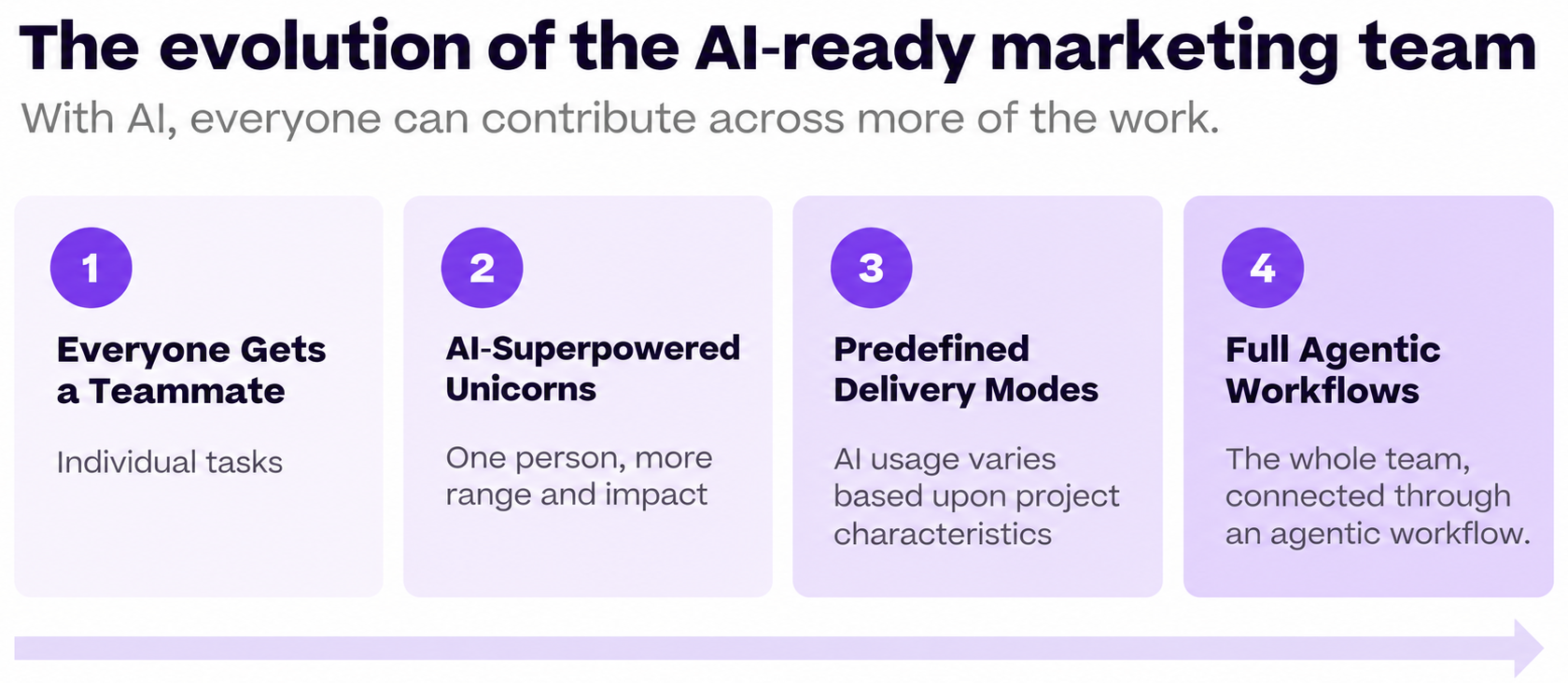
Here’s the model I've been using, and the one I presented at ANA. Four stages, each of which changes something structural about the team.
Stage 1: Everyone Gets a Teammate. Every role picks up an AI teammate that works inside the job they already do. The change is individual: every role starts from a better first draft.
Stage 2: AI-Superpowered Unicorns. One experienced marketer, with real AI leverage, covers ground that used to take five people. The change is range: one person carries a brief end to end—and teaches the rest of the team how.
Stage 3: Predefined AI Delivery Modes. Before work starts, you decide how much of the execution AI carries. The change is the team model itself: you set cost and speed up front instead of discovering them at the end.
Stage 4: Full Agentic Workflows. AI stitches the lifecycle together and carries context across campaigns. The change is the unit of work: months of lifecycle compress into days, and every campaign makes the next one smarter.
A few things to say about the model before anyone takes it too literally.
It's not a ladder. You don't finish Stage 1 and graduate. Most teams will run all four simultaneously on different kinds of work—a brand platform at Stage 1, a social calendar at Stage 4.
It's also not a maturity score to feel bad about. Stage 1 done well beats Stage 4 done badly, every time. The point isn't to get to the end. It's to be deliberate about which stage a given piece of work belongs in.
What this is really about
The framing that's dominated the last two years is human versus AI. Who wins, what gets replaced, how many jobs.
I think that framing is why so many teams are stuck. It turns a design question into a threat, and people don't design well under threat.
The teams pulling ahead aren't choosing sides. They're building something specific: human-led, AI-powered teams. Human judgment setting direction. Specialized talent where craft still matters. AI capability carrying the execution load that doesn't need a person.
The marketing unicorn is still human. AI just gives more marketers the ability to work like one—with greater range, fewer barriers and more time for the judgment and creativity that still require a person.
That’s the opportunity for marketing leaders: not replacing people with AI but rethinking what people and teams can accomplish with it.
No items found.
No items found.
To learn more about any or all of these solutions, contact your Wripple Client Lead, or request a demo.
About this blog series: AI is changing what marketers can do—and how marketing teams get work done. In this series, we explore the evolution of the AI-enabled marketing team, from giving every marketer an AI teammate to building connected, agentic workflows. The goal: human-led, AI-powered teams that deliver better work, faster.
Every marketing leader I've ever talked to has looked for a unicorn.
The definition varies a little, but not much: someone who can think strategically, write well, brief creative that doesn't come back wrong, read the numbers without a translator, and actually ship. One person, most of the range.
They're rare, they're expensive, and you can't clone them. So, teams do the sensible thing and hire specialists—a strategist, a planner, a creative, a copywriter, a media lead, an analyst—and accept the tax that comes with it. Handoffs. Alignment meetings. Context loss between every pair of hands. The brief gets a little worse each time it changes owners.
For the last two years, the assumption baked into most AI conversations has been that this problem gets solved by deletion. AI writes the copy, AI builds the plan, AI reads the data, and the unicorn becomes unnecessary because the work becomes automatic.
That's not what I've watched happen.
AI didn't replace the unicorn. It lowered the cost of becoming one.
What actually changed is the barrier between disciplines.
The strategist who was never a writer can now produce a credible first draft and edit it into something good. The copywriter who avoided the analytics dashboard can ask it questions in plain English. The planner who used to wait three weeks for an audience study has it in an afternoon and spends the saved time on the part that actually needed them.
None of these people became experts in someone else's craft. That's not what happened, and pretending otherwise is how teams get in trouble. What happened is that they stopped being blocked by someone else's craft.
That's the shift worth naming: with AI, everyone can be more unicorn-like.
Not a unicorn. More unicorn-like. Wider range, fewer hard stops, less waiting.
Why "everyone gets a tool" isn't a strategy
Here's where most organizations are stuck. Everyone has access to something. A few people are very good with it. Nobody has decided what any of it means for how the team is structured, how work gets scoped, or how it's paid for.
That's not a strategy. That's a stack of subscriptions.
The teams making real progress are treating this as an organizational question, not a tooling question. They're asking how the work itself should be shaped when AI is in it—which is a different question from which model to license.
And the honest answer is that it depends on how far along you are. A team where three people are experimenting with ChatGPT has a different next move than a team already running connected workflows. Lumping them together under "AI adoption" hides the thing that matters.
A four-stage model
Here’s the model I've been using, and the one I presented at ANA. Four stages, each of which changes something structural about the team.
Stage 1: Everyone Gets a Teammate. Every role picks up an AI teammate that works inside the job they already do. The change is individual: every role starts from a better first draft.
Stage 2: AI-Superpowered Unicorns. One experienced marketer, with real AI leverage, covers ground that used to take five people. The change is range: one person carries a brief end to end—and teaches the rest of the team how.
Stage 3: Predefined AI Delivery Modes. Before work starts, you decide how much of the execution AI carries. The change is the team model itself: you set cost and speed up front instead of discovering them at the end.
Stage 4: Full Agentic Workflows. AI stitches the lifecycle together and carries context across campaigns. The change is the unit of work: months of lifecycle compress into days, and every campaign makes the next one smarter.
A few things to say about the model before anyone takes it too literally.
It's not a ladder. You don't finish Stage 1 and graduate. Most teams will run all four simultaneously on different kinds of work—a brand platform at Stage 1, a social calendar at Stage 4.
It's also not a maturity score to feel bad about. Stage 1 done well beats Stage 4 done badly, every time. The point isn't to get to the end. It's to be deliberate about which stage a given piece of work belongs in.
What this is really about
The framing that's dominated the last two years is human versus AI. Who wins, what gets replaced, how many jobs.
I think that framing is why so many teams are stuck. It turns a design question into a threat, and people don't design well under threat.
The teams pulling ahead aren't choosing sides. They're building something specific: human-led, AI-powered teams. Human judgment setting direction. Specialized talent where craft still matters. AI capability carrying the execution load that doesn't need a person.
The marketing unicorn is still human. AI just gives more marketers the ability to work like one—with greater range, fewer barriers and more time for the judgment and creativity that still require a person.
That’s the opportunity for marketing leaders: not replacing people with AI but rethinking what people and teams can accomplish with it.
Author: Shannon Denton
Shannon Denton is Co-Founder and CEO of Wripple, an on-demand talent platform helping companies build and manage flexible marketing teams. Previously Global CEO of Razorfish, Shannon has spent his career at the intersection of technology, marketing, and organizational transformation. Today, he works with marketing leaders navigating the impact of AI on talent, teams, and operating models, with a focus on building more agile, high-performing organizations.